Part 1
Testbed & passage detection
CARLA capture, Mininet-WiFi replay, learned packet grouping, and anonymous passage-event export.
Explore Part 1IoTAE Workshop · 2026
GrayTrack
Electrical and Computer Engineering · University of California, Los Angeles
* Equal contribution
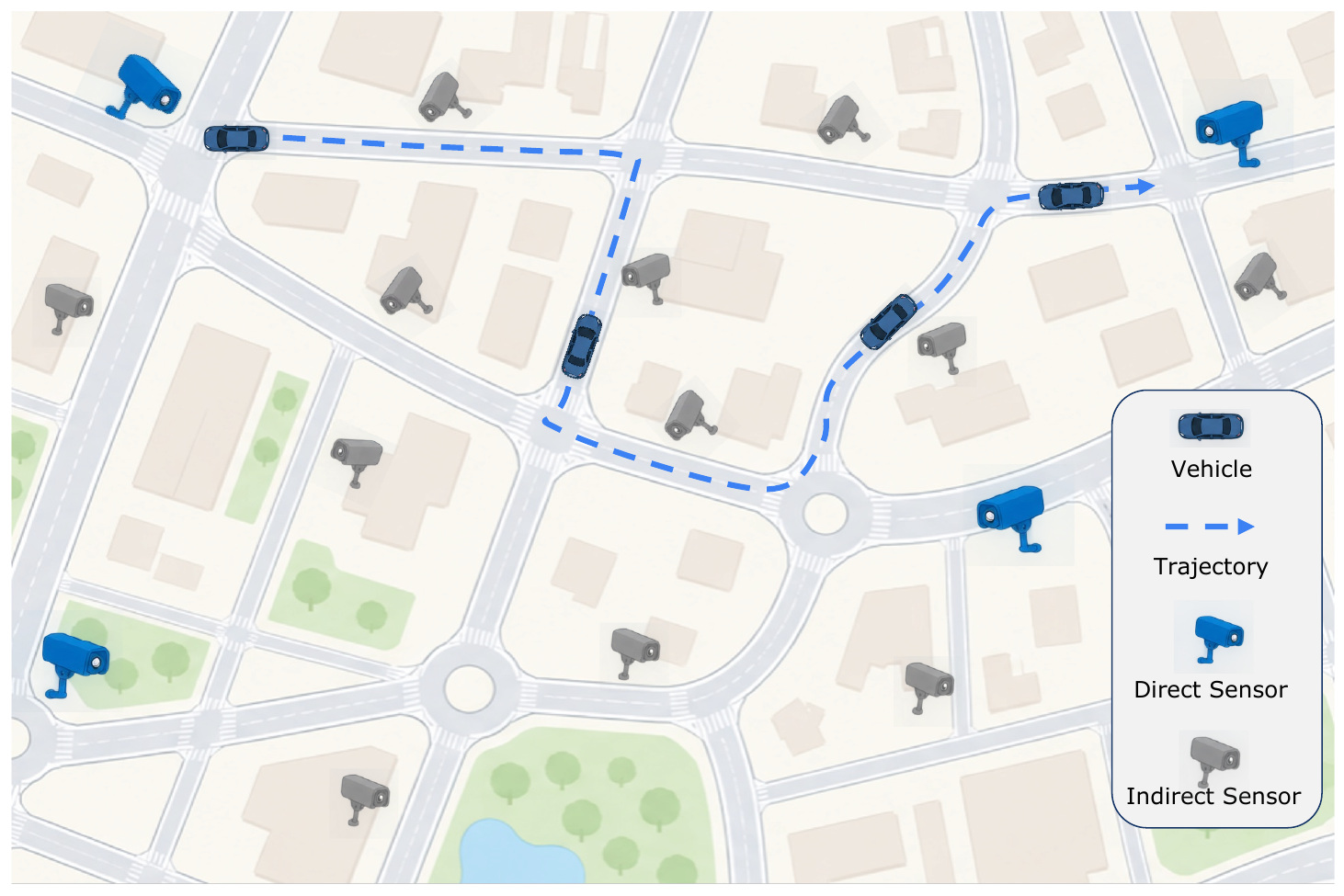
Directly accessible sensors are often sparse, leaving long gaps in vehicle tracking. Additional third-party sensors may be nearby, but their raw data remain inaccessible. GrayTrack combines weak, anonymous passage events from these “gray assets” with sparse direct observations using a road-constrained particle filter. We build a CARLA–Mininet-WiFi pipeline that infers passages from encrypted camera-traffic metadata and evaluates their value for downstream tracking. The detector achieves an event-level F1 of 0.989. Incorporating indirect observations reduces trajectory RMSE by 60.1% and catastrophic track loss from 35.8% to 0.3%, demonstrating that even weak observations can extend tracking coverage.
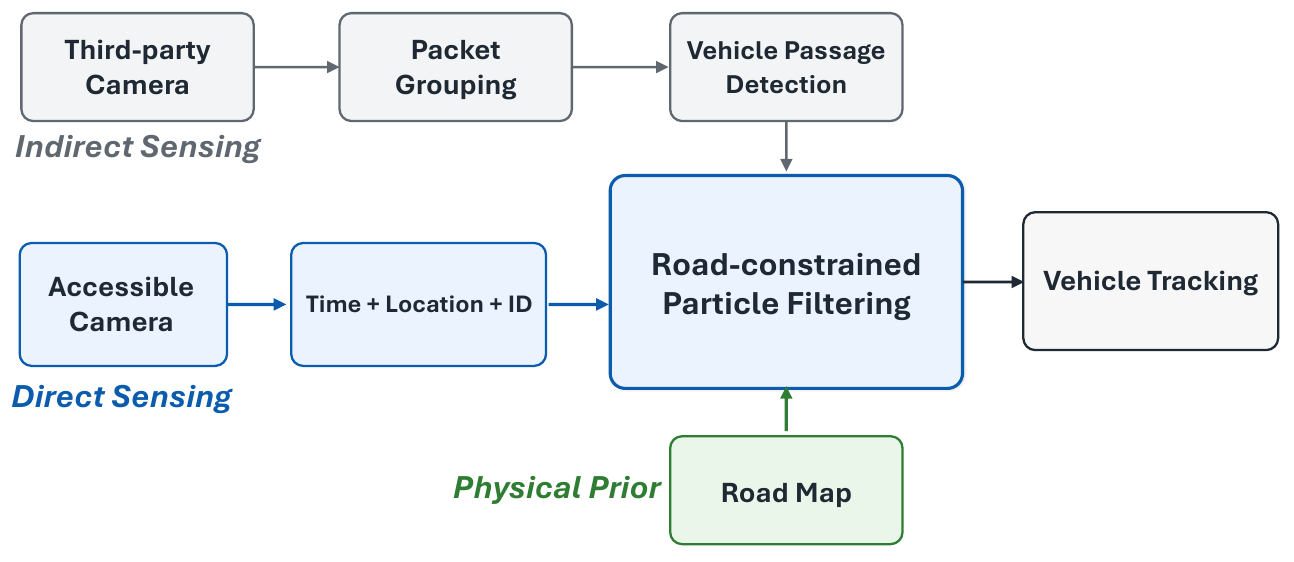
Tracking results compare Road-PF with direct observations alone against direct observations plus noisy indirect events at measured detector error rates.
Part 1
CARLA capture, Mininet-WiFi replay, learned packet grouping, and anonymous passage-event export.
Explore Part 1Part 2
Road-PF and tracking baselines, with experiments on sensing noise, blind gaps, and multiple vehicles.
Explore Part 2The arXiv version is coming soon. Download BibTeX
@misc{dong2026graytrack,
  title  = {Beyond Direct Sensing: Harnessing Indirect Observations from Third-Party Sensors in Vehicle Tracking},
  author = {Dong, Gaofeng and Eyunni, Vamsi and Sharma, Pragya and Yang, Kang and Srivastava, Mani},
  year   = {2026},
  url    = {https://nesl.github.io/GrayTrack/},
  note   = {arXiv version forthcoming}
}