NetWaggle Layer
The NetWaggle layer injects latency, jitter, loss, and topology between
nodes. It is optional: a config with no links block runs without any
network emulation.
Channels vs links
CADET separates two kinds of connections:
Channels are direct data paths with no emulation. A channel connects two nodes over a plain TCP socket with no qdisc installed and no delay added. The netem backend excludes channel traffic from its filter rules, so channels sharing an interface with a shaped link are never accidentally delayed.
Links are emulated-network paths. Every link has a NetworkModel
block (network.mode, distribution, loss, bandwidth). The orchestrator
installs the backend at startup and removes it on teardown, even after a
crash.
The rule is structural: channels cannot have a network block, and
links cannot be promoted to channels after the fact.
Three backends
Mode |
Granularity |
Where it runs |
Delay semantics |
Use when |
|---|---|---|---|---|
|
Message-level |
In-process (transport) |
Sampled per application message; distribution honoured per message |
You want a specified latency distribution without TCP interaction |
|
Packet-level |
|
Applied per packet; TCP reacts (Nagle, retransmit, CWND) |
You want to see how a real protocol stack behaves on a degraded path |
|
Packet-level |
Mininet-WiFi in a privileged container |
Same as netem, plus propagation model for wireless links |
You need a real topology, wireless medium, or mobility |
Why netem and delay report different numbers
A 60 ms forward link configured identically under delay and netem
produces very different measured latencies:
delaybackend: p50 ≈ 60 ms (message-level)netembackend: p50 ≈ 149 ms (TCP Nagle doubles the round trip)
With mode: delay, the delay lives inside the transport, so the ACK
returns without crossing the qdisc and Nagle never holds a write. With
mode: netem, the qdisc sits on the interface; the ACK is itself behind
the 60 ms delay, so the sender waits 60 ms for the ACK, then sends, then
waits another 60 ms for the response.
Setting transport_tuning.tcp_nodelay: true on the sending node
disables Nagle and brings the same netem run to p50 ≈ 110 ms.
Loss semantics
With mode: delay, messages are dropped at the application layer.
A 1% loss setting produced approximately 1.25% unanswered frames in the
reference experiment (Bernoulli variation).
With mode: netem or mode: netwaggle, packets are dropped at the
kernel layer and TCP retransmits them. The same 1% setting produced 0%
unanswered frames and appeared as elevated p99 latency instead.
Shaping refusals
CADET refuses a netem or netwaggle link if:
p99 > 2 * p50(the symmetric jitter would need negative delays on the low side).Jitter is non-zero but
bandwidth_mbpsis not set (netem reorders packets without a rate serialiser).The link originates from a remote node (
launcher: ssh_docker). The orchestrator has no handle on the remote machine’s network namespace and cannot attach a qdisc there. Shape that path from the local end instead.
See Configure link distributions for valid config examples and Network Backend Semantics for the full backend comparison.
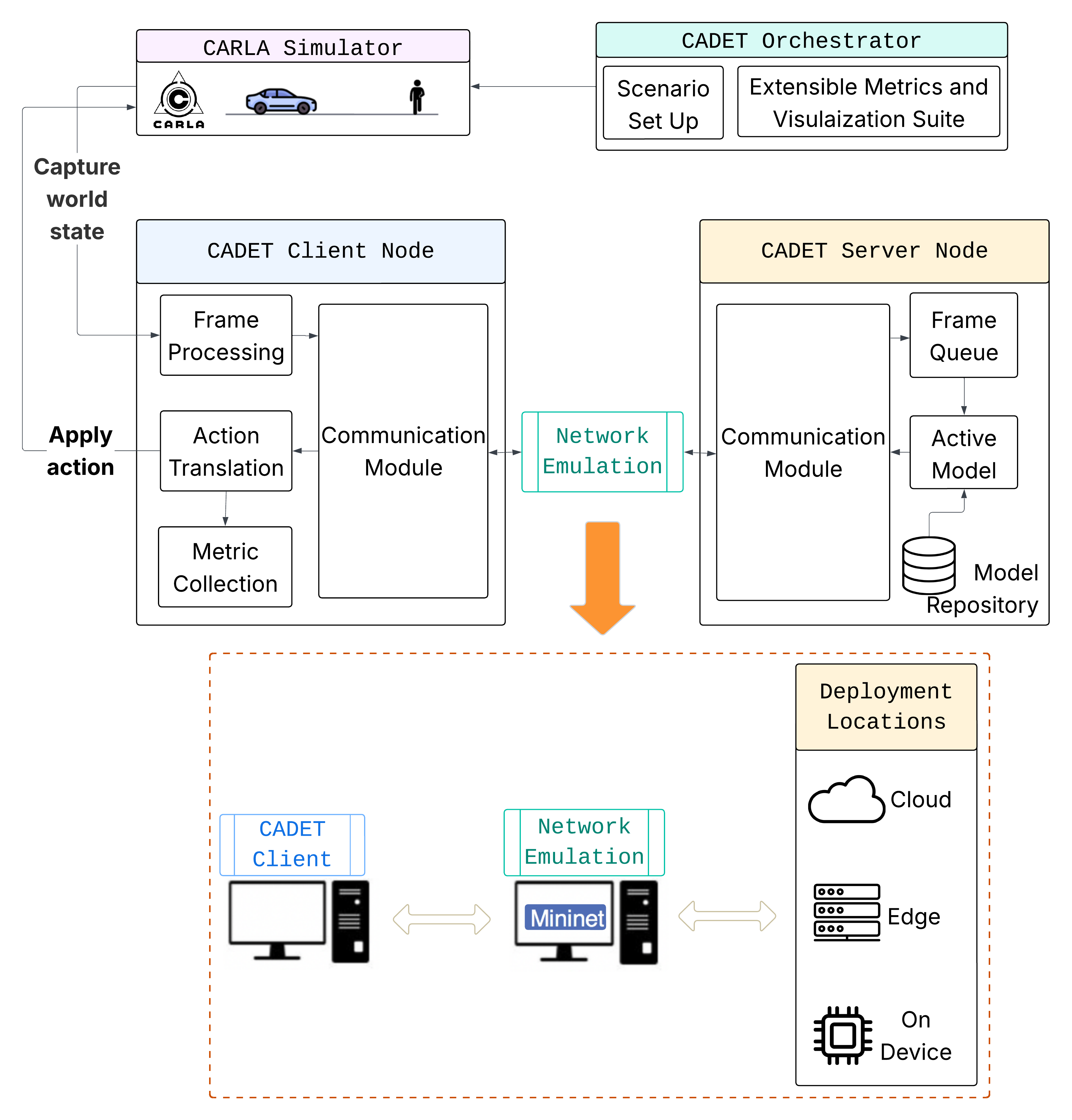
(b) NetWaggle enables distributed inference under device heterogeneity and realistic network dynamics. It adopts a client–server design and mimics real-world network profiles. (Figure from the CADET paper.)
Multi-hop routes
routes.realise: compose gives one end-to-end connection per sensor whose
configured hops’ delays add. In the cloud configs, each sensor has a
composed path from sensor → gateway → cloud server; the sensor observes the sum
of the access link and the backhaul delays. The N composed paths do not contend
for one backhaul queue.
So a number from one composed path is that sensor’s own path, and not a share of a contended backhaul.