CADET
Cooperative Autonomy through Distributed Experimentation Toolkit.
CADET runs controlled experiments on distributed cyber-physical and autonomy systems. Connect your application to a simulator, recorded data, datasets or live sensors; run its components on one machine or across real devices (hardware in the loop); emulate the network between them (message-level delay, kernel netem, or Mininet/Mininet-WiFi via NetWaggle); sweep parameters across a full matrix; and get per-frame latency, age of information, energy and link statistics for every run, with a dashboard and LLM-assisted log analysis.
Application domains include autonomous vehicles (V2V cooperative braking, V2I infrastructure-assisted perception), multi-sensor networks (multi-sensor fan-in, detector placement sweeps), model benchmarking (YOLO variants across link conditions), and any perception pipeline that separates data capture from inference by a network hop.
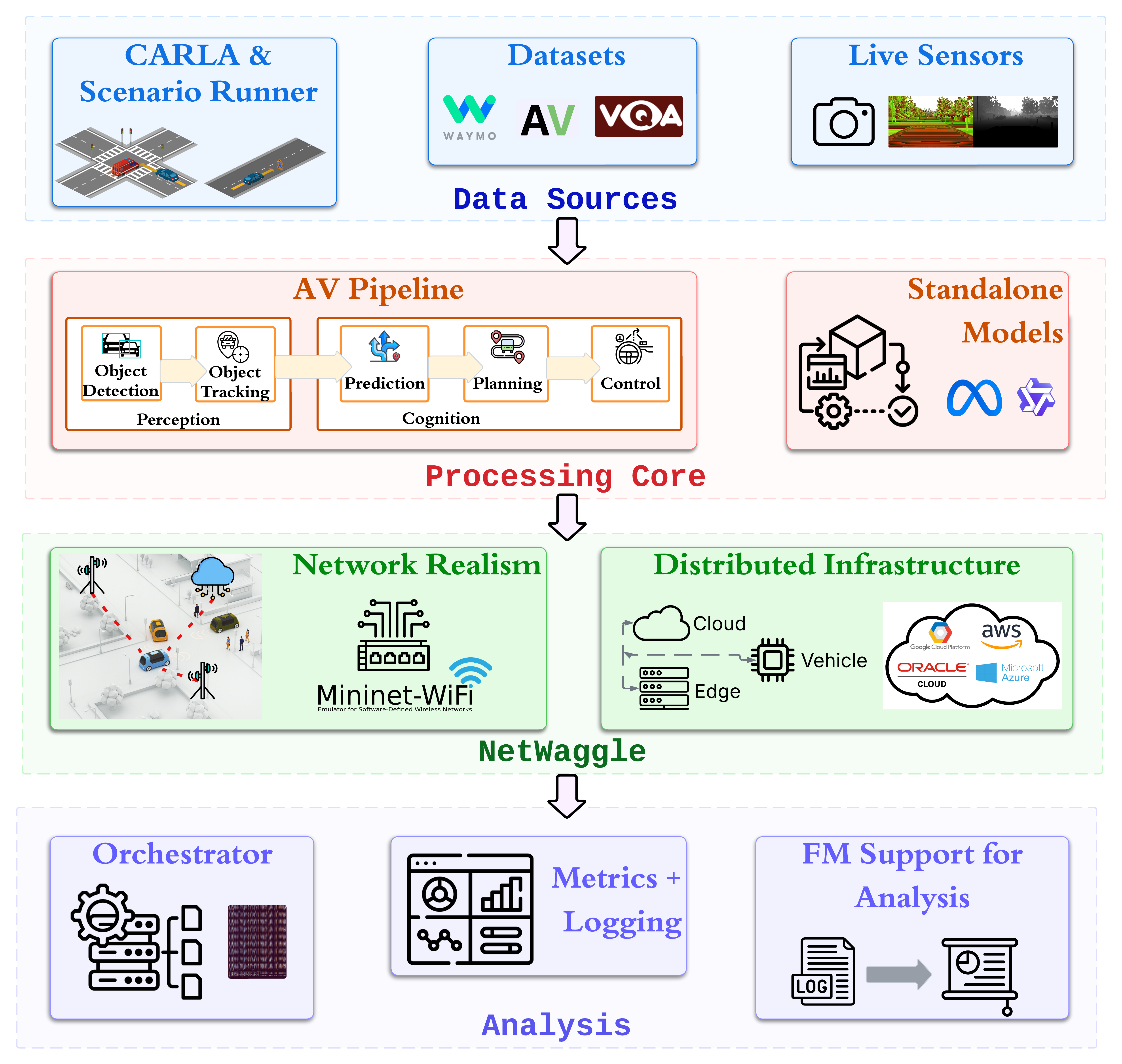
(a) CADET implements a modular four-layer architecture allowing components to be evaluated in isolation or integrated for end-to-end cooperative autonomy experiments. (Figure from the CADET paper.)
Get started
git clone https://github.com/nesl/cadet
cd cadet
pip install -U pip
pip install -e ".[examples]"
cadet run examples/distributed_sensing/quick.yaml \
    --app-module examples.distributed_sensing.app
Quick links
Quickstart: install, validate, and run your first experiment
Choose Your Research Goal: map your research question to CADET layers
Ways to Use CADET: reproduce, configure, or extend
Examples Gallery: AV, distributed sensing and dataset benchmarks
Tested configurations: every source x processing x network x infrastructure combination verified
Architecture: how the four layers fit together
API Reference: Python API reference
Citing CADET: how to cite this work
What each layer gives you
Data Source — feed any experiment
CARLA 0.9.10 simulator (fixed-timestep, async control loop) for AV scenarios
Replay from an images directory or video file — reproduce any run offline
Synthetic in-memory source — no simulator, no GPU, runs in seconds
Live sensor: camera device index or network stream URL (RTSP, HTTP)
Dataset: VQAv2/COCO images and questions, scored against ground truth
Tutorial 1: First Experiment (Replay + Reference App + Delay Link) · Use the replay source · Use the synthetic source · Live source
Processing Core — swap perception without touching orchestration
Model registry maps logical names to per-device artifact paths (
gpu,edge,hailokeys); CADET selects the right artifact for each node’sdevicefieldBraking pipeline: detect → ROI-gate → brake decision, config-wired; general detection / tracking / prediction stages via app plugins
Dataset mode: benchmark a vision-language model on public datasets (VQAv2, COCO) across device/edge/cloud placements
FM-assisted analysis: summarise and query any run’s logs with a language model (
cadet summarize/cadet ask)Register per-device model artifacts · Tutorial 6: Write an App Plugin · Dataset-mode VLM serving
NetWaggle — three levels of network realism
delay: message-level, exact distribution (constant, normal, lognormal, trace)netem: packet-level viatcinside node containers — TCP retransmit visiblenetwaggle: Mininet-WiFi wired topology viacadet emulateAll three backends support loss, bandwidth caps, and Cartesian sweeps over link parameters
Tutorial 3: Comparing Network Backends · Configure link distributions · Wi-Fi cell · Network Backend Semantics
Analysis — full lifecycle, metrics, and results dashboard
Orchestrator lifecycle: cleanup → preflight → netem → server → sim → client;
dockerandssh_dockerlaunchers for containerised and multi-machine runs;ssh_venvfor remote Python environment deploymentsCartesian sweep with content-derived run IDs; interrupt and resume any sweep
Per-run metrics: frame latency, age of information, link report, queue depth, GPU/CPU/energy/bandwidth collectors, per-run clock-offset measurement
Results dashboard (
cadet dashboard): live sweep matrix, crossover plot, per-run and per-device views — all inline SVG, nothing fetched from the networkWebSocket transport (
transport.protocol: websocket) for links that cross HTTP-only infrastructureTutorial 4: Multi-Device Deployment · Tutorial 5: Sweeps and Reproducibility · Dashboard · Metrics Reference
Paper
See Citing CADET for the full citation and BibTeX entry.