Inside a CREST trial
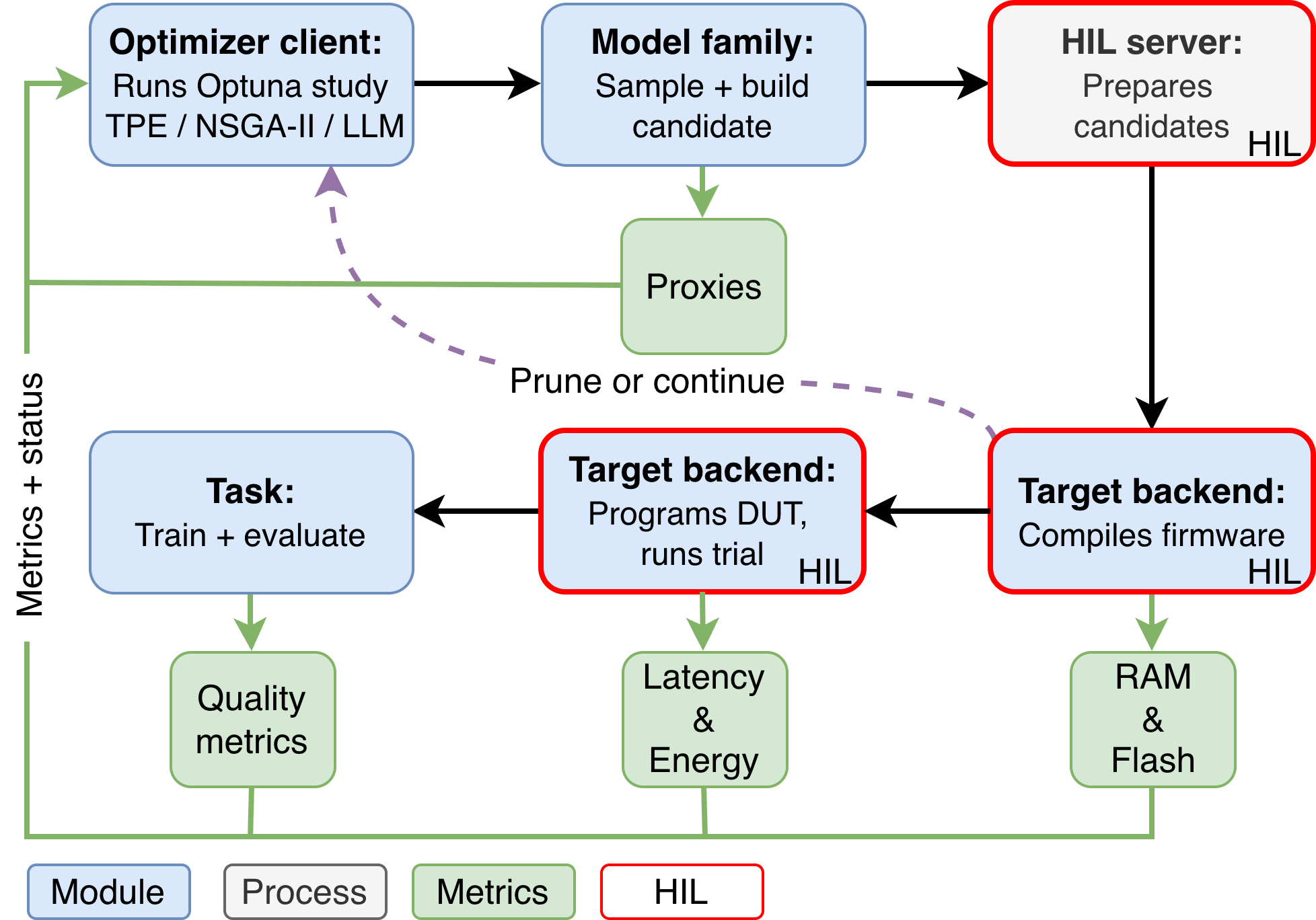
Follow a candidate from the optimizer to the target board and back. CREST brings task quality, memory, latency, and energy into the decision to prune a trial or continue the search.
Explore the documentation
Built-in example workloads and targets
| Example workload | Dataset | Model family | Example configuration |
|---|---|---|---|
| Inertial odometry | OxIOD | Temporal convolutional network (TCN) | Proxy search |
| Audio classification | UrbanSound8K log-mel features | Depthwise-separable CNN (DS-CNN) | STM32 audio search |
Hardware backends currently support Arduino Nano 33 BLE Sense, Arduino Portenta H7 (CM7 and CM4), and STM32 NUCLEO-N657X0-Q. To add support for another target, see how to add a hardware backend.
Energy measurements use a separate harness MCU and an INA228 power monitor. Follow the hardware guide for board and toolchain setup.
For more information, read the full project README on GitHub.